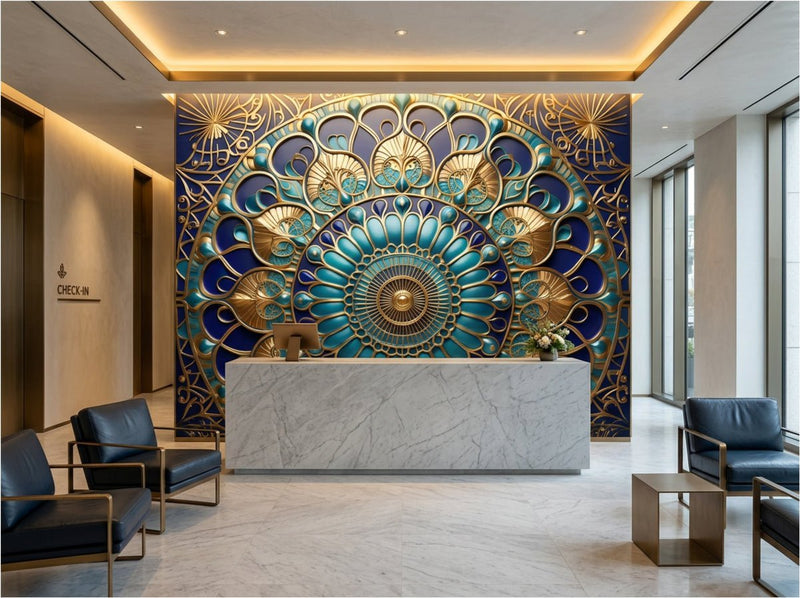
Most wallpaper decorates a wall. An architectural mural replaces it with a piece of building: a row of arches, the inside of a dome, a carved stone screen. The wall is still flat, but the room reads as if it had depth and structure it was never built with.
A very old trick
Painting architecture onto flat walls is about as old as interior decoration. Roman houses at Pompeii had walls painted with columns, cornices and views through imaginary openings. In the Renaissance, Andrea Mantegna painted a ceiling in Mantua that appears to open to the sky, with figures looking down over a balustrade. Baroque painters went further: Andrea Pozzo’s ceiling in the church of Sant’Ignazio in Rome continues the real architecture upwards into a painted one so convincingly that there is a marked spot on the floor from which it lines up.
The French name for the effect is trompe-l’œil, “deceive the eye”. A printed mural does the same job with less labour, and it comes off the wall again.
Three kinds of architectural mural
- Arch wall murals and arcades. Archways and colonnades that suggest space beyond the wall. The Romanesque Archway is a cloister of rounded arches and columns with gentle shadows. The Riad Archway layers Moroccan arches in stucco tones, like a courtyard in sun.
- Carved and inlaid surfaces. Prints that look like worked stone, timber or metal. Mughal Jali Screen echoes perforated stone screens. The Mamluk Shadow has a carved, brass-inlaid look. The Alhambra Geometric draws on the star lattices of Alhambra courtyards.
- Domes and instruments. Radial compositions with a centre. Ottoman Dome turns the geometry of a dome onto a wall. The Celestial Void is built from astrolabe geometry.
To be clear about what you receive: all of these are flat printed wallpaper. The relief, the shadow and the depth are drawn into the image.
How to make the illusion hold
- Give it a whole wall. Painted architecture works when it runs from corner to corner and from skirting to ceiling. Cut off halfway, it becomes a picture of a building.
- Match the light. The shadows in the print fall from one side. Where you can, put the mural on a wall where the real window light comes from the same direction.
- Keep furniture low and simple. A bed, a long table or a low sofa sits well in front of arches. Tall cabinets break the illusion.
- Let the floor line agree. Arcades have a ground line. It should sit at or just above your skirting, not float at knee height.
- Use real materials nearby. Stone, lime plaster, linen, oak and unlacquered brass make a printed arcade more believable. High-gloss surfaces work against it.
Where they work best
Corridors and stair halls are the natural home, because architecture seen in passing is architecture at its most convincing. Dining rooms come next: a table set in front of an arcade looks like a table in a loggia. In bedrooms, a single arch or a quiet screen behind the bed gives a plain room a focal point without colour.
Sizing
Architectural murals have to fit the wall, not just cover it. Panels are 76 cm wide in four lengths from 244 to 366 cm. On each product page, Customise your wall takes your width and height, shows where the seams fall and previews the design at the right proportions. The estimation guide explains the arithmetic.
See the group together in the Architectural Statements Collection, and order a printed 76 × 51 cm sample before you commit. The printed shadows are the thing to check in your own light.