The dining room is the one room in a house that is used mostly at night, sitting down, under lighting you control. Nobody works there or sleeps there. That is why it takes a bold wall better than any other room: you see the pattern for two hours at a time, in warm light, with people in front of it.
These are the directions that work, and the practical rules that decide between them.
Dark murals for candlelight
A dark wall disappears at the edges after sunset, so the table becomes the brightest thing in the room. Detail in the pattern then shows only where the light reaches it, which is what makes a dark dining room feel calm rather than heavy.
- The Persian Garden Tapestry is a tapestry-like garden scene with trees, blossoms and ornamental borders. It reads as one large picture, so it suits the wall you face from the door.
- The Petrified Oasis sets fossilised desert flora in dark volcanic stone. It has almost no colour, which leaves the table, the glass and the food to supply it.
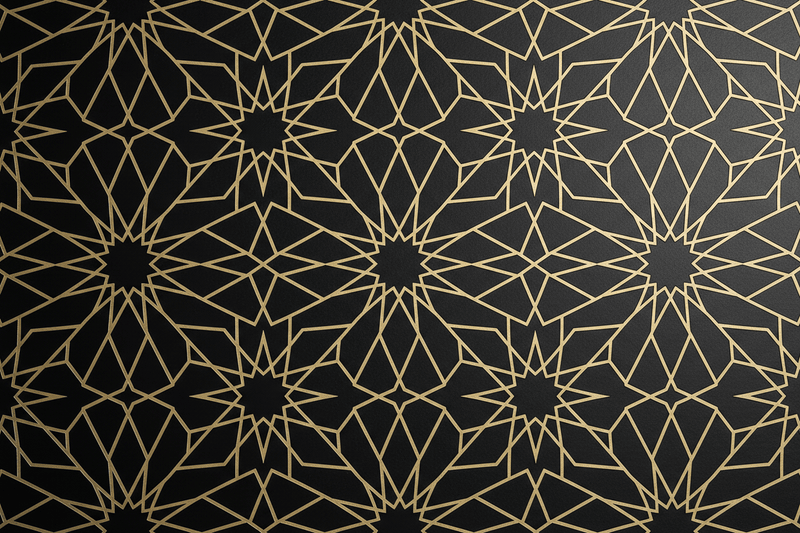
- The Alhambra Geometric is an interlocking star lattice in gold line on deep blue. Geometry gives a long table a formal backdrop without a picture to compete with.
Garden scenes in daylight
If the room is also where breakfast happens, a pale or green ground is easier to live with from morning to night. The Andalusian Courtyard frames orange trees and jasmine in tile-like borders, after the patios of Córdoba and Seville. Mughal Jungle fills the wall with trees and foliage inspired by Mughal miniature painting. Pomegranate Dreams is the lightest of the three and works well in a small dining nook.
Quiet walls for a room with a view or strong furniture
Not every dining room needs a statement. If the table, the chairs or the view already carry the room, choose a pattern that reads as texture from a distance. Damask of the Dunes is an arabesque damask over a woven, linen-like ground in warm sand tones. It gives the walls depth without asking to be looked at.
Accent wall, chair rail or the whole room?
- An accent wall is right for a dining room wallpaper mural with a centre, such as a garden scene or a large geometric panel. Put it on the wall you see from the doorway, or the wall at the head of the table.
- All four walls suit an even repeat. A wrapped room feels enclosed in a good way at night, which is the point of a dining room.
- Above a chair rail or wainscoting is the traditional answer and still the most forgiving. The lower wall takes the knocks from chairs, and the pattern sits at seated eye level.
Four practical rules
- Judge the scale sitting down. You will mostly see the wall from a chair, about 1.2 m from the floor. A motif that starts above head height when seated is wasted.
- Use warm light and point it at the wall. Wall washers or picture lights at around 2700 K bring a dark mural to life. A single pendant over the table leaves the wall flat.
- Art or wallpaper, not both. One large mirror or one framed piece can sit on a quiet pattern. A scenic mural should be left alone.
- Keep the sideboard low. Tall furniture cuts a mural in half. A long, low piece lets the picture run behind it.
Before you order
Every design is printed to order in the EU on non-woven wallpaper, as numbered 76 cm panels in four lengths, in non-pasted, pre-pasted or peel-and-stick. Shipping is free worldwide. Order the printed 76 × 51 cm sample first and look at it at the hour you normally eat, under the lights you will actually use.
See every design suited to the room in Dining Room Wallpaper and Murals, or work out your panel count with the estimation guide.