Zellij is the hand-cut ceramic mosaic work you find on the walls, floors and fountains of Morocco — thousands of individually chiselled pieces assembled into geometric patterns that have been made more or less the same way for a thousand years. It is one of the traditions we draw on most heavily, and it is worth understanding before you try to bring any version of it into a room.
Where it came from
The word zellij (also written zellige or zillij) comes from Arabic. The craft appears in North Africa around the 10th century and reaches its height under the Marinid dynasty in Morocco, roughly the 13th to 15th centuries. The Marinids built prolifically, and zellij became a signature of their palaces and religious buildings.
The technique almost certainly owes something to Byzantine and Roman mosaic. What changed it was the Islamic preference for abstraction over figurative imagery in sacred space. Instead of scenes and figures, the mosaic became governed by geometry — which turned out to be a far more generative constraint than it sounds.
How it is actually made
You start with plain terracotta tiles, fired, then glazed and fired again. A maalem — master craftsman — cuts each piece by hand with a small pointed hammer called a menkach. Stars, diamonds, triangles, hexagons, and the awkward interlocking shapes that fill the gaps between them.
The pieces are then laid out face-down, following the pattern in reverse, set into mortar and grouted. The panel is turned over at the end. Craftsmen who have done this for decades still describe that moment as the good part.
A square metre of complex zellij can take days. The work in the royal palaces at Fez, or at the shrine of Moulay Idriss, represents skill handed down through particular families over generations — not a technique you learn from a book.
The geometry underneath
What makes these patterns hold your attention is that they are mathematically real, not decorative approximations. The designs are constructed with compass and straightedge, using the same geometry that medieval Islamic mathematicians and astronomers were developing at the time.
Most grids divide the circle into 6, 8, 10 or 12 parts, which produces the star polygons that define the tradition. Each has a different character. The 8-pointed star is stable and symmetrical. The 10-pointed star has a slight restlessness to it. The 12-pointed star gets close to crystalline.
This was not purely aesthetic. In the intellectual tradition these patterns came out of, geometry was understood as a visible trace of divine order — the mathematics underlying creation, made into something you could stand in front of. Living inside geometric pattern was a form of contemplation.
Related traditions elsewhere
Morocco is the heartland, but the family is wider. In Andalusia, the Nasrid rulers of Granada developed alicatado, which you can see across the Alhambra. In Iran and Central Asia, comparable tilework covers the mosques and madrasas of Isfahan, Samarkand and Bukhara. In Ottoman Turkey, Iznik developed its own vocabulary, weaving floral forms through the geometry.
Each reflects local clay, local patronage and local taste. All of them treat geometry as the primary language rather than an ornament applied on top.
Bringing it into a room
The direct route is real tile. Authentic Moroccan zellij is available through specialist importers and looks extraordinary in a kitchen, bathroom or entrance hall. It also needs skilled installation, sealing, and a budget that surprises most people.
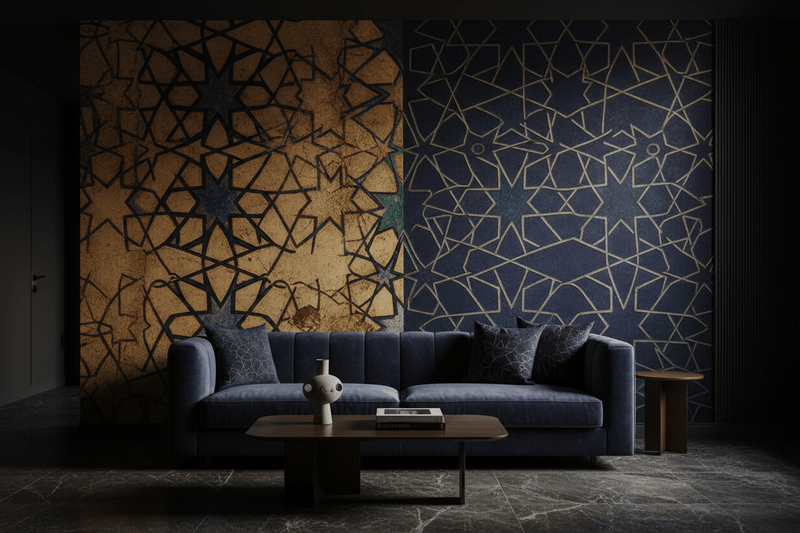
The practical alternative is geometric wallpaper drawn from the same source. You lose the physical depth of glazed ceramic. You keep the pattern density and the rhythm, at a fraction of the cost and without a tiler on site for a fortnight.
If you go that way, the thing worth checking is whether the pattern is geometrically constructed or merely styled to look Moroccan. The difference shows. Properly constructed geometry has an inevitability to it — lines meet where they should, and the eye settles. Loose interpretations feel subtly wrong without you being able to say why. Our Alhambra design is built on the same star-polygon logic as the tilework it comes from.
Zellij geometry also translates well into textiles, perforated metal lighting that throws patterned shadows, and small objects — trays, mirrors, ceramics. The main risk is overdoing it. One or two elements anchoring a room works. Four or five reads as a theme park.
Colour
Traditional palettes are saturated, which makes sense under North African light — cobalt with white, or turquoise against terracotta and black. In a European interior with less sun, those combinations can feel loud.
Monochrome is the usual solution: one colour family in several tones. You keep the geometric complexity and lose the shout. Deep navy, forest green and warm terracotta all take this treatment well.
A closing thought
Zellij is still being made, by hand, in Fez and Marrakech, by people whose grandfathers made it. That continuity is unusual and worth respecting when you borrow from it.
Our geometric collections come out of these mathematical traditions rather than a mood board of them — redrawn for contemporary rooms and printed to order in the EU. Samples are the sensible first step if something here caught your eye.