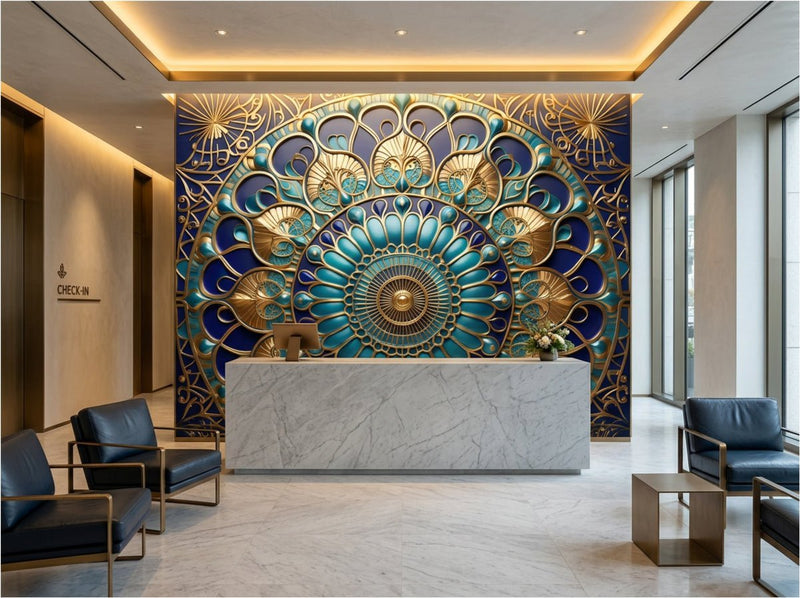
A logo is seen at check-in and on the bill. A wall is seen for the whole stay, and it is in the background of every photograph a guest takes. Used deliberately, pattern is one of the most economical ways for a hotel or restaurant group to be recognised from one property to the next.
Here is how wallpaper does that job, and how to plan it.
1. A signature pattern
The simplest approach is one pattern that belongs to the brand and appears in a predictable place: behind every reception desk, in every lift lobby, or on the headboard wall of every room. Guests may not be able to describe it, but they recognise it. The pattern does the work that repeated signage would do, without looking like signage.
2. One family, local variations
Groups that do not want every property to look the same use a pattern family instead. The geometry or the drawing style stays constant, and the colourway or the motif changes with the location. A coastal property and a city property can share a star lattice in different grounds, and still feel related.
A collection drawn in one hand makes this easy. An arcade in the corridor, a lattice in the lounge and a radial dome in the lobby clearly belong together even though no two walls match.
3. Zoning and wayfinding
Pattern tells people where they are. A different design or colour on each floor’s lift lobby helps guests find their room. A change of wall at the entrance to the restaurant marks the threshold more gracefully than a sign. In long corridors, a rhythm of bays or arches breaks the distance into parts.
4. The wall that gets photographed
Every property has one or two places where guests take pictures: the bar, the staircase, the entrance. A distinctive wall in that spot travels further than any advertisement, because it arrives with a recommendation attached. Plan for it: decide which wall it is, light it properly, and keep it clear of clutter. Our custom hotel wallpaper ideas go through it room by room.
5. A story that belongs to the place
Pattern with a real source gives staff something to say when a guest asks. A design drawn from Ottoman dome geometry, Moroccan zellige or a Persian garden carpet connects the room to a tradition, and that is more convincing than a generic “luxury” finish.
6. Consistency you can repeat
A brand standard is only useful if it can be reproduced. With printed-to-order wallpaper, the specification is a file, a panel width and a panel schedule. That means:
- the same design can be printed for the next property, sized to its own walls;
- a damaged section can be reprinted instead of re-papering a whole room;
- panels arrive numbered in hanging order, so different installers produce the same result.
A simple framework
- Choose three patterns: a hero for arrival, a supporting pattern for circulation, and a quiet one for guest rooms.
- Map them to the guest journey: entrance, reception, lift lobby, corridor, room, restaurant, bar.
- Fix the rules: which wall in each zone, which colourway, what lighting.
- Check compliance early: ask your fire consultant what each zone requires and get test reports before anything is specified. Our guide to hotel wallcoverings lists the questions.
- Sample at full scale: approve a large printed sample on site, in the real lighting.
Where Carta Noor fits
Our designs share one drawing language, so they combine naturally: Ottoman Dome is designed for arrival walls, Mughal Jali Screen and The Riad Archway for circulation, Midnight Medina for bars and restaurants, and Damask of the Dunes for rooms. Everything is printed to order in the EU as 76 cm panels in four lengths.
Browse Hotel and Restaurant Wallpaper, or contact us through the trade programme with your elevations and the standards your project must meet.