People often use "arabesque" and "Islamic geometric" as if they're the same thing. They're related, but they're built on almost opposite logic — and knowing the difference makes choosing a pattern for your own wall much easier.
Geometric: the mathematical grid
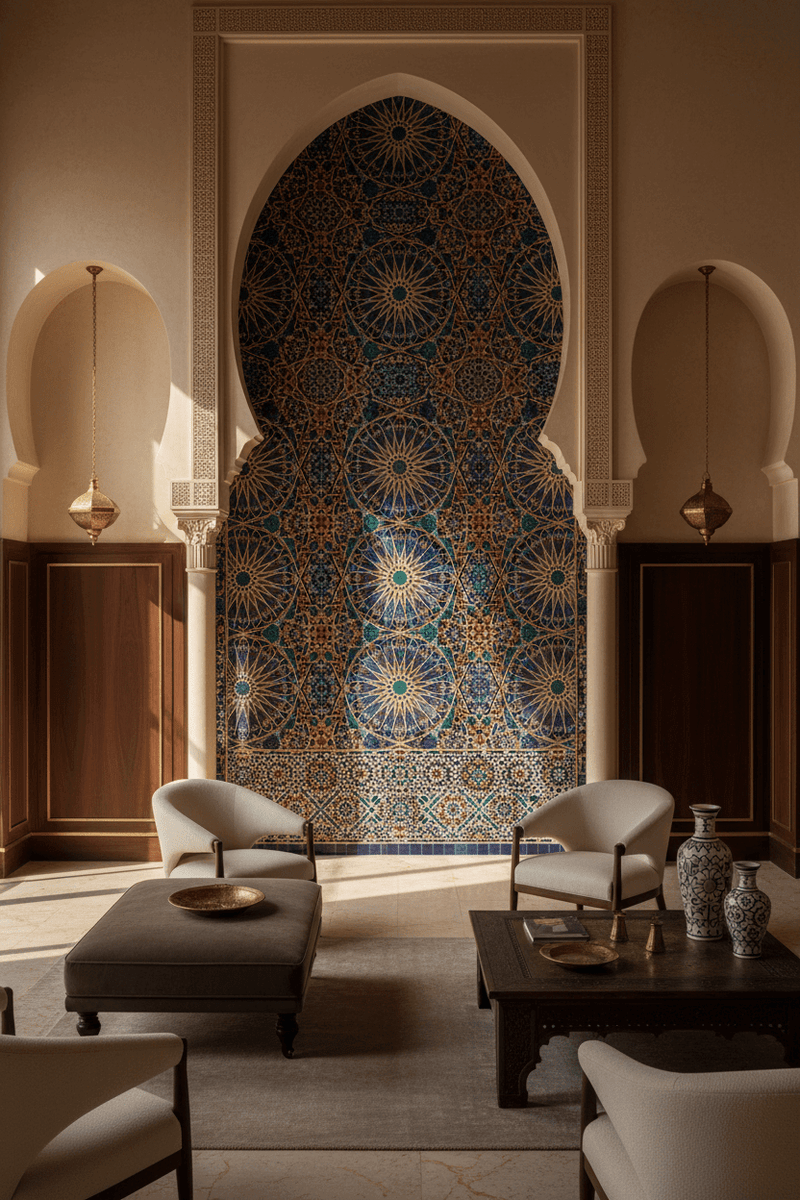
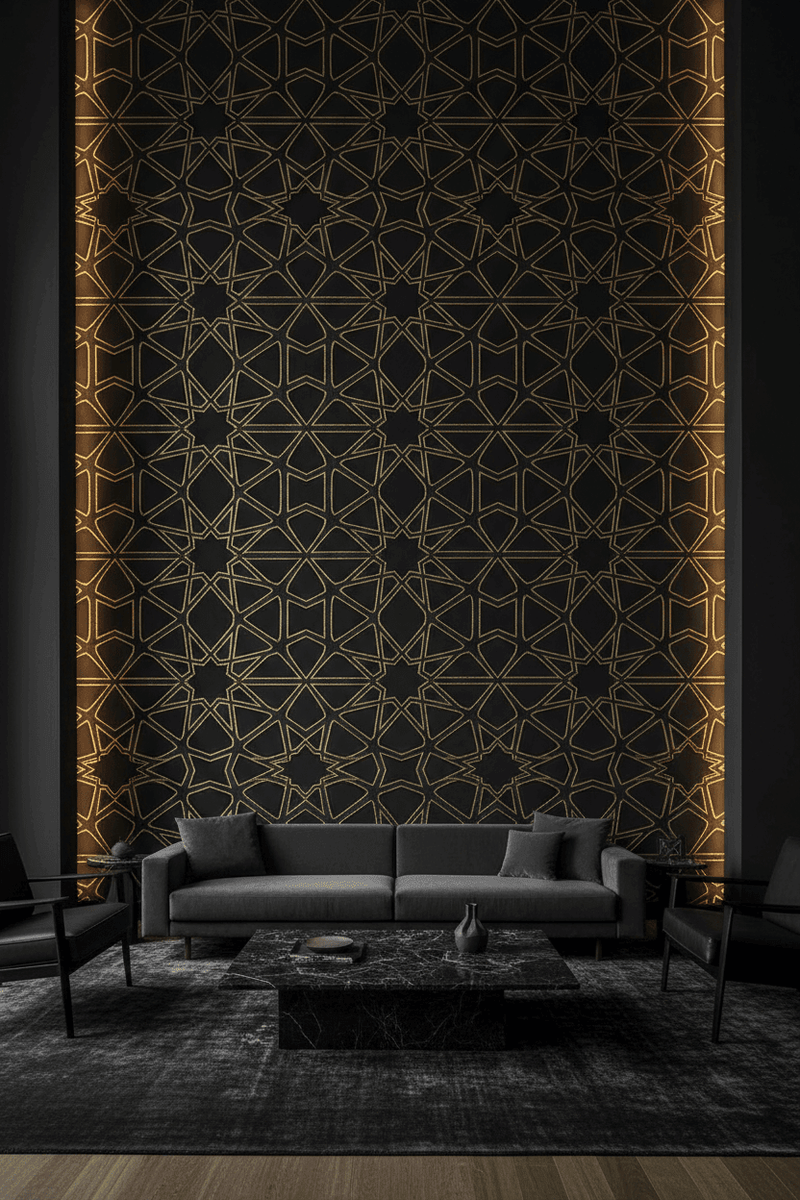
Geometric pattern — the star polygons, the interlocking lattice work you see in zellij and Alhambra tilework — is built from a compass-and-straightedge grid. Every point, every intersection, is derived mathematically from a division of the circle. It's rigid, precise, and reads as architectural. Our Alhambra Geometric design sits squarely in this tradition.
Arabesque: the organic line
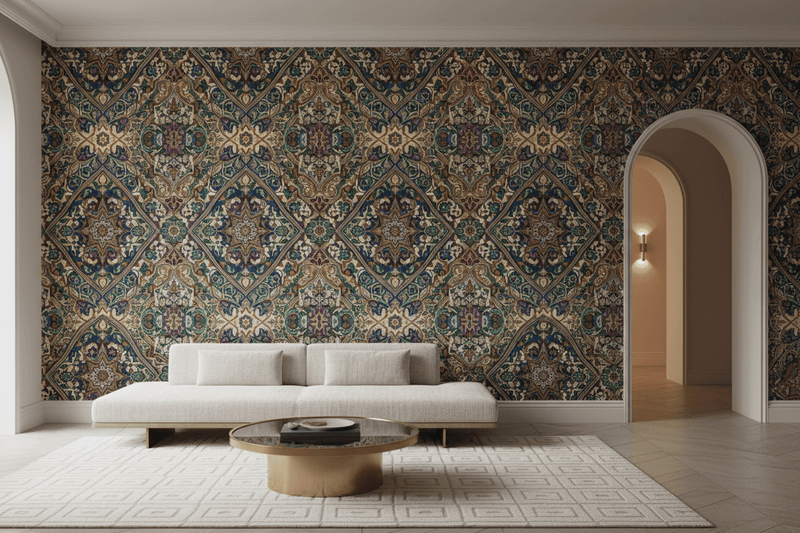
Arabesque is a different system entirely. Instead of a grid, it's built from a single continuous stem that bifurcates, curves and returns on itself — an endless, self-generating vine-scroll rather than a fixed pattern of intersecting lines. It's the logic behind classical Islamic damask: pattern and ground rendered in the same colour but different textures, so the design emerges and recedes depending on the light and the angle you view it from. Our Damask of the Dunes design translates that tone-on-tone logic directly onto a wall surface.
Why the distinction actually matters when choosing a pattern
- Want structure and visual rhythm → geometric. It gives a room a sense of order and works well as a bold, graphic feature wall.
- Want texture and quiet depth without a loud pattern → arabesque. Tone-on-tone arabesque reads as a refined neutral from across the room, revealing its detail only up close — which is why it works so well in hotel suites, bedrooms and offices that need atmosphere without competing with furniture or art.
- Want both → many historic interiors layer them — geometric structure on a lower dado, arabesque scrollwork above, or geometric on a feature wall with an arabesque neutral on the rest of the room.
Seeing them side by side
The easiest way to feel the difference is to compare samples directly. Order a printed 76 × 51 cm sample of both a geometric and an arabesque design and hold them against the same wall to see how differently they behave in your light.
The short version
Geometric pattern is mathematics made visible; arabesque is a single organic line that never repeats the same way twice. Both come from the same broader Islamic design tradition, but they solve very different problems on a wall — one brings structure, the other brings quiet texture.
Browse both traditions or order samples to compare.