The ceiling is the largest uninterrupted surface in most rooms, and the only one with no furniture, doors or pictures in front of it. Designers call it the fifth wall. Papering it is less common than papering a wall, which is exactly why it has such an effect.
Where a wallpapered ceiling works
- Bedroom. It is the one room where you actually look at the ceiling. A pattern overhead with plain walls is calmer than the reverse.
- Dining room. People sit for a long time and look up between courses. A ceiling pattern centred on the pendant or chandelier gives the table a canopy.
- Hallway and stair hall. Narrow spaces have little wall you can see properly. The ceiling is the clear surface.
- Study or library. When the walls are full of shelves, the ceiling is the only place left for pattern.
Ideas by ceiling type
Flat ceilings
Paper the whole field and leave a painted border of 10 to 20 cm around the edge, or stop the paper at a cornice. The border makes the ceiling look intended rather than wrapped.
Coffered ceilings
Paper inside the coffers and leave the beams plain. Each coffer becomes a framed panel, and concealed lighting around the edges makes the pattern glow. This is the easiest ceiling to paper well, because every piece is small.
Ceilings with beams
Treat the spaces between beams like long coffers. The beams hide the joins, so you can use a pattern with a clear direction.
Tray and recessed ceilings
Paper the raised centre only. The step in the ceiling acts as a frame.
Which patterns work overhead
A ceiling is seen from every side of the room, so the best patterns have no top or bottom.
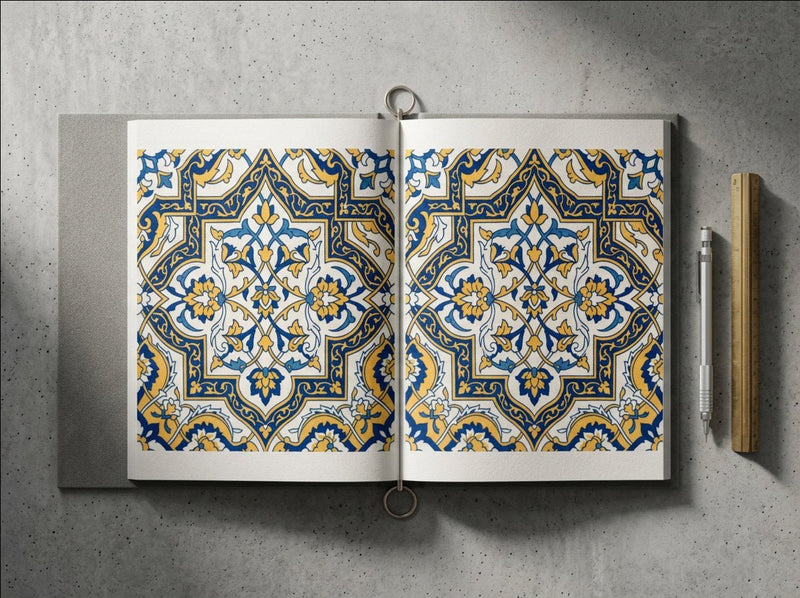
- All-over lattices. Paisley, Safavid Garden Lattice is an eight-pointed star lattice filled with garden botanicals. It reads the same from any direction and was drawn with coffered ceilings in mind.
- Radial designs. Ottoman Dome has a single centre, like the dome it comes from. Place that centre over the table or under the light fitting.
- Star maps. The Astral Meridian draws constellation lines on deep blue, which is an old idea for a ceiling.
Avoid scenic murals with a horizon, and anything with figures or trees that will be upside down from half the room.
Light or dark?
A dark ceiling lowers a room visually. In a tall room that is welcome. Under about 2.5 m, choose a pale ground with a fine pattern, or keep the pattern inside a recessed area. Matte finishes are kinder overhead than shiny ones, because a ceiling catches light at a low angle and shows every ripple.
Measuring a ceiling
Measure it like a wall lying down. Panels are 76 cm wide, so divide one dimension of the room by 76 and round up for the number of panels. The other dimension is the panel length.
One limit to plan for: our longest panel is 366 cm. If both dimensions of the room are longer than about 3.6 m, panels have to be joined end to end. Put that join where it will not be noticed, along a beam, a lighting track or the edge of a coffer. If your ceiling is that large, send us the dimensions before ordering and we will suggest a layout. The estimation guide covers the arithmetic.
Hanging it
- Ceilings are harder to paper than walls. It is a two-person job, and a professional installer is worth it.
- Non-woven wallpaper helps: the paste goes on the ceiling and the dry panel is offered up to it, so there is no heavy wet paper to hold overhead.
- Ask your installer which finish they prefer for overhead work before you order.
- Prepare the surface properly. Ceilings show cracks and old paint lines more than walls do.
- Decide the position of light fittings first, and switch the power off at the board before any fitting is removed.
Test the idea first: order a printed 76 × 51 cm sample, tape it to the ceiling and look at it lying down, sitting, and from the doorway.