Persian floral design has been travelling for five hundred years. It went from Safavid palace workshops into carpets, from carpets into Kashmir shawls, from there into Scottish printed cotton, and eventually onto half the sofas in Europe. Which means that when you put it on a wall today, you are joining a very long queue — and that is rather the point.
Where it comes from
The high period is the Safavid dynasty, 1501 to 1736. Carpet weaving, manuscript illumination, tilework and architectural decoration all peaked under Safavid patronage, and much of it organised itself around one idea: the chahar bagh, the four-part garden divided by water channels and planted with flowering trees.
That garden was not just a place. It was an image of divine abundance and order — paradise, made buildable. The flowers filling Persian decorative art are fragments of it, rendered in silk, glaze or pigment. Knowing that changes how the patterns read. They are not decoration for its own sake; they are a picture of somewhere.
Three motifs worth recognising
Boteh, which became paisley
The boteh — Persian for bush or cluster — is the teardrop with the bent tip that the West eventually named after a town in Scotland. It appears in Persian textiles from at least the Safavid period. What it originally represented is unsettled: a cypress, a flame, a leaf. All three readings point at life and continuity.
The garden composition
Flowering plants, trees, sometimes birds, arranged in a structured symmetrical layout that mirrors the plan of a real garden. It appears in both carpets and tilework, and it moves to wallpaper more comfortably than almost any other historical pattern type — the wall becomes a view rather than a surface.
Arabesque florals
Spiralling stems that branch, flower, and branch again from the flower. The pattern generates itself. That is what gives Persian arabesque its movement — your eye gets pulled in and led around rather than simply landing on a motif and stopping.
Using it in a room that is not a palace
The obstacle is rarely compatibility. These patterns have survived translation across cultures and centuries; a contemporary flat is not going to defeat them. The obstacle is usually nerve — people hang a quarter of what the pattern needs and it looks apologetic.
Living rooms
A warm ground — deep red, saffron, aged ivory — anchors a seating arrangement well. It sits naturally with wool, silk and dark wood. It sits badly with chrome and cold minimalism, which fight it rather than support it.
Bedrooms
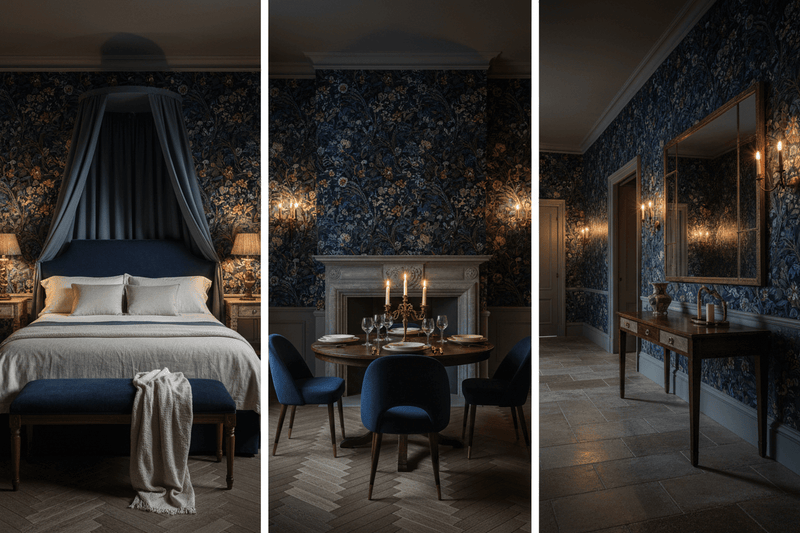
The garden idea earns its keep here, since a bedroom is also meant to be a refuge. Behind the bed, a dense floral creates something like a canopy. Go deep on the ground colour — midnight blue, forest green, plum. Pale florals in a bedroom tend to read as timid.
Studies
Persian florals get on well with books, leather and accumulated clutter. A dark ground with gold or jewel-toned flowers suits a room where things pile up, because the pattern absorbs visual noise instead of competing with it.
Colour, practically
- Warm grounds — red, saffron, terracotta. Pair with aged brass, warm timber, wool. Keep the whole room warm; one cold element undoes it.
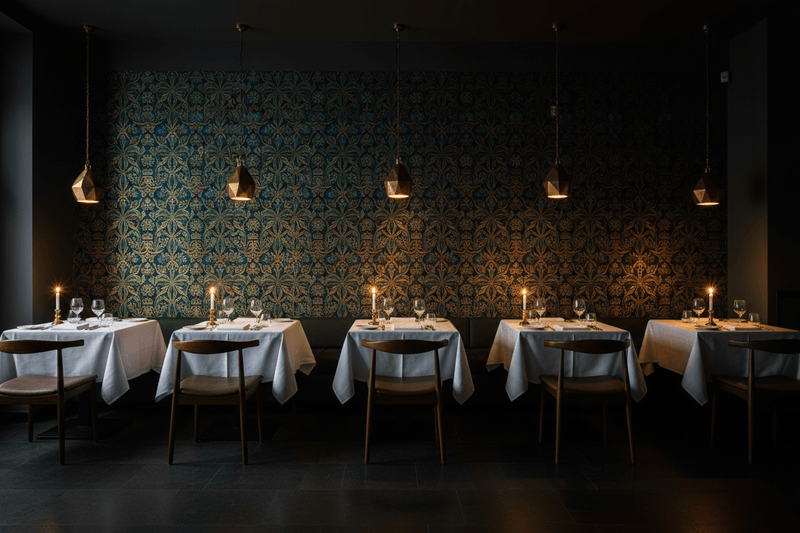
- Dark grounds — midnight blue, forest green, plum. Want gold, silk and warm lighting. Cool white bulbs will kill them.
- Ivory grounds — the flexible option. Works warm or cool, and holds up in strong daylight where saturated grounds can bleach.
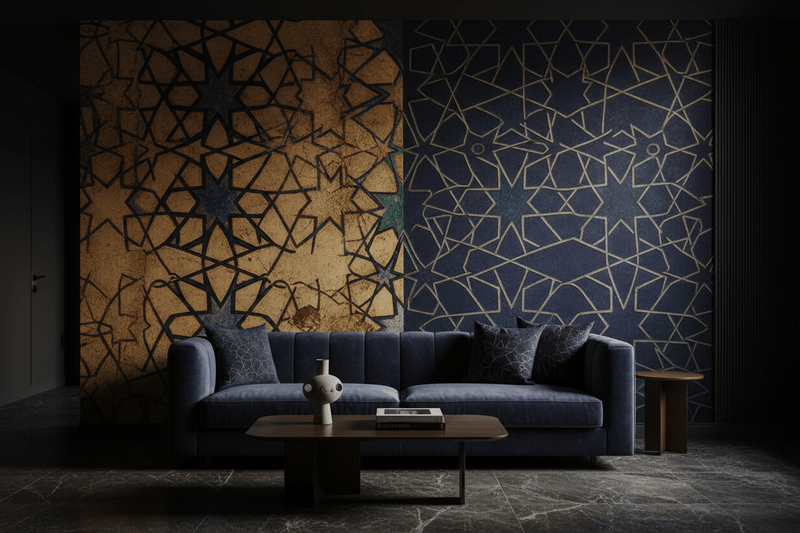
- Layering pattern — Persian interiors always layered: carpet over tile, textile over plaster. A geometric rug alongside a floral wall is historically correct, not a mistake. Vary the scale and keep the palette tight.
How we work with it
Our botanical patterns are researched from primary sources rather than assembled from other people's interpretations, then redrawn and printed to order at the scale of your wall.
The Storyteller's Garden collection is where most of the Persian work sits. As always, get a sample onto the actual wall before committing — dark grounds in particular behave very differently in a real room than on a screen.